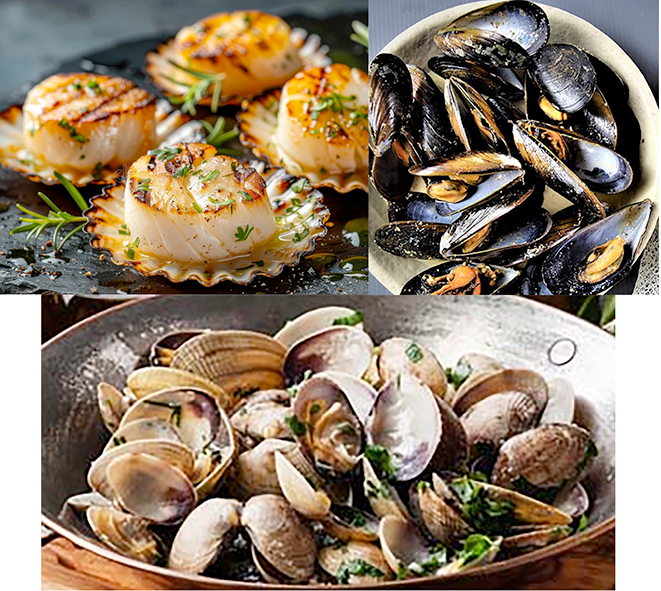
 Cooked scallops and mussels, top and clams (bottom).
Welcome to FabulousFusionFood's Shellfish-based Recipes Page —Shellfish, in colloquial and fisheries usage, are exoskeleton-bearing aquatic invertebrates used as food, including various species of molluscs, crustaceans, and echinoderms. Although most kinds of shellfish are harvested from saltwater environments, some are found in freshwater. In addition, a few species of land crabs are eaten, for example Cardisoma guanhumi in the Caribbean. Shellfish are among the most common food allergens. In my usage here I'm excluding crustaceans (eg prawns, lobsters, crayfish, crabs and barnacles) which have their own page. Though this page deals mainly with molluscs, I am excluding cephalopods (squids, octopodes, cuttlefish) but including gastropods (aquatic species such as whelks and winkles; land species such as snails and slugs). So my usage is closer to the regulatory definition of 'shellfish', which is often narrowly defined as filter-feeding molluscs such as clams, mussels, and oyster to the exclusion of crustaceans and all else.
Archaeological finds have shown that humans have been making use of shellfish as a food item for hundreds of thousands of years. In the present, shellfish dishes are a feature of almost all the cuisines of the world, providing an important source of protein in many cuisines around the world, especially in the countries with coastal areas.
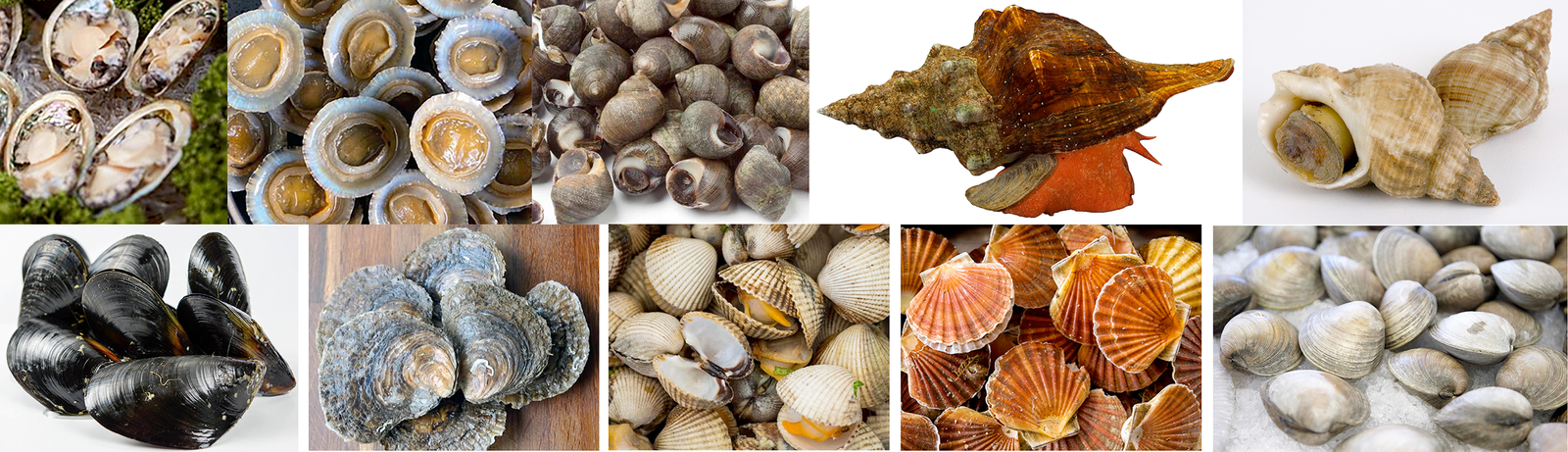 Examples of edible molluscs, top layer gastropods: abalone, limpets, winkles, conch, whelks.
Bottom layer bivalves: mussels, oysters, cockles, scallops and clams.
Molluscs used as a food source by humans include many species of clams, mussels, oysters, winkles, and scallops. In terms of gastropods, conch is particularly important in the Caribbean diet, winkles are enjoyed in the UK and periwinkles are an important flavouring (used dried) in many West African Soups and stews. Whelks are eaten in the Caribbean and Europe. Molluscs are a large phylum of invertebrate animals, many of which have shells. Edible molluscs are harvested from saltwater, freshwater, and the land, and include numerous members of the classes Gastropoda (snails), Bivalvia (clams, scallops, oysters etc.), Cephalopoda (octopus and squid) [though I am excluding cephalopods here], and Polyplacophora (chitons).
Many species of molluscs are eaten worldwide, either cooked or raw. Some mollusc species are commercially exploited and shipped as part of the international trade in shellfish; other species are harvested, sold and consumed locally. Some species are collected and eaten locally but are rarely bought and sold. A few species of molluscs are not commonly eaten now, but were eaten in historical or prehistoric times.
Some of the most commonly consumed molluscs and marine gastropod snails include: abalone (several species), true limpets, winkles (including periwinkles), conchs, several species of
Calliostoma top snails, whelks, sea snails, bivalves (these have two shells and include: ark clams, true mussels, pen shells, true oysters, true cockles, scallops, venus clams, Mectridae clams, razor clams, bean clams, chitons). Note that abalone, limpets, winkles, conchs Callliostoma top snails, whelks and sea snails are all gastropods ie true snails. Some also include edible land snails such as escargot and giant African snails in this list.
The alphabetical list of all the shellfish-based recipes on this site follows, (limited to 100 recipes per page). There are 376 recipes in total:
Page 4 of 4
Scolloped Mussels
Origin: British | Sticky Asian-style Pork Neck Chops
Origin: Britain | Tom Yum Hed
(Mushroom Tom Yum)
Origin: Thailand |
Scolloped Oysters
Origin: British | Stir-fried Clams in Black Bean Sauce
Origin: Hong Kong | Tom Yum Het Mangsawirat
(Mushroom and Lemongrass Soup)
Origin: Thailand |
Scottish Chinese Takeaway Chicken
Curry
Origin: Scotland | Stir-fried Scallops
Origin: Fusion | Torta di patate e Funghi selvatici
(Wild Mushroom and Potato Cake)
Origin: Italy |
Seafood Amok
Origin: Cambodia | Stir-fried Scallops with Asparagus
Origin: Fusion | Trout Kedgeree
Origin: Britain |
Seafood and Bacon Kebabs
Origin: Britain | Stiw Pysgotwr
(Fisherman's Stew)
Origin: Welsh | Turbot à la Bechamel
Origin: British |
Seafood Chili
Origin: American | Stufato del Pescatore
(Italian Fisherman's Stew)
Origin: Italy | Turbot à la Normande
Origin: British |
Seafood Curry
Origin: Scotland | Stuffed and Baked Carp
Origin: British | Turbot à la Parisienne
Origin: British |
Setas al Horno
(Baked Oyster Mushrooms)
Origin: Spain | Surf and Turf Kebabs
Origin: Britain | Vermicelli with Chicken and Wood Ear
Mushrooms
Origin: China |
Shellfish Forcemeats
Origin: Roman | Tanrogans and Cheese Sauce
Origin: Manx | Warm Salad of Oyster Mushrooms
Origin: Britain |
Shellfish Seaweed Pudding
Origin: Ancient | Taro aux Fruits de Mer
(Taro with Seafood)
Origin: Cote dIvoire | White Curry
Origin: Fusion |
Sint Maarten Whelk Soup
Origin: Sint Maarten | Teisen Frau Noswaith Lawen
(Pan-fried Parsnips and Mushrooms with
a Garlic and Parsley Crust)
Origin: Welsh | White Matelotte Sauce
Origin: Britain |
Sizzling Scallops
Origin: Britain | Teisennau Cocos
(Cockle Cakes)
Origin: Welsh | White Oyster Sauce
Origin: Britain |
Smoked, Preserved, Mussels
Origin: Britain | Thai Crab and Sea-blite Curry
Origin: Thailand | Wild Mushroom and Miso Broth
Origin: Britain |
Smoked, Preserved, Oysters
Origin: Britain | Thai-style Nettle and Oyster Mushroom
Curry
Origin: Britain | Wild Mushroom Compote
Origin: Britain |
Smoked, Preserved, Scallops
Origin: Britain | Thiebou Kéthiakh
(Rice with Dried Fish, Seafood and
Vegetables)
Origin: Senegal | Wild Mushroom Omelette
Origin: Britain |
Sole or Cod Pie
Origin: British | Tianmianjiang
(Jiangsu Crayfish Cooked with
Thirteen-Spice Powder)
Origin: China | Wild Mushroom Stew
Origin: Britain |
Sopa de Caracol
(Honduran Conch Soup)
Origin: Honduras | To boil a Capon or Hen with Oysters
Origin: British | Wild Mushroom Stuffed Potato Cakes
Origin: Britain |
Soupe Kandja
Origin: Mali | To force a large fowl
Origin: British | Wontons
Origin: China |
Southern Oyster Dressing
Origin: American | To force cucumbers
Origin: British | Xarém
Origin: Portugal |
Spaghetti alle vongole e Salicornia
(Spaghetti with Clams and Samphire)
Origin: Italy | To hash a calf's head
Origin: British | Xiao Long Xia
(Garlic-braised Crayfish)
Origin: China |
Special Fried Rice with Oxeye Daisy
Greens
Origin: Fusion | To hash a calf's head white
Origin: British | Xuyi Shisanxiang Longxia
(Jiangsu Crayfish Cooked with
Thirteen-Spice Powder)
Origin: China |
Spicy Beef and Longevity Noodles
Origin: China | To make a grand Sallet of minced
Capon, Veal, roast Mutton, Chicken or
Neats tongue.
Origin: British | Yi Mein
(Longevity Noodles)
Origin: China |
Spring Rolls with Pork and Shrimp
Origin: China | To make a Pie with Parsneps and
Oisters very good
Origin: British | Zarzuela de Mariscos
(Seafood Zarzuela)
Origin: Spain |
Stewed Beef with Oysters
Origin: British | To make Shropshire pie
Origin: British | Zupa di Pesce
(Seafood Soup)
Origin: Cayman Islands |
Stewed Oysters
Origin: British | To ragoo a neck of veal
Origin: British |
Stewed Scallops in Milk
Origin: Britain | Tobago Curry Conch with Dumplings
Origin: Trinidad |
Page 4 of 4