FabulousFusionFood's Hannah Glasse's Recipes from the Georgian Age 2nd Page
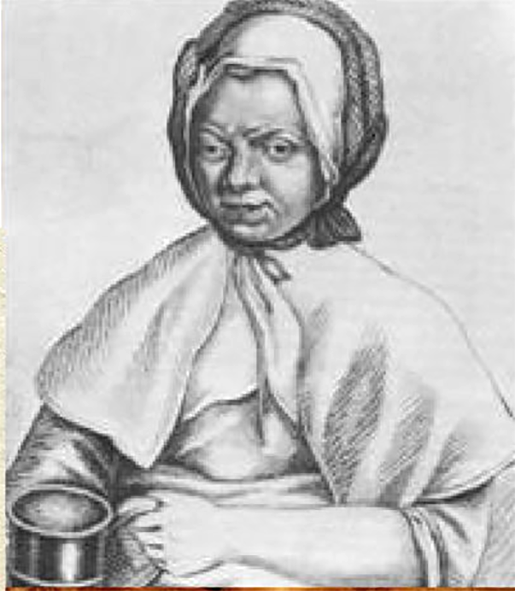 Sketch of Hannah Glasse 1708–1770.
Welcome to FabulousFusionFood's Hannah Glasse Recipes Page — was an English cookery writer. Her first book, The Art of Cookery Made Plain and Easy, published in 1747, became the best-selling recipe book that century.
Hannah Glasse
1708–1770
Hannah Glasse was born in London in March 1708, the illegitimate daughter of Hannah Reynolds, a widow, and Isaac Allgood, a landowner of Brandon and Simonburn, both in Northumberland. She was christened at the church of St Andrews, Holborn, London, but she was raised at Allgood’s home at Simonburn near Hexham, together with his legitimate children, Lancelot and Isaac. Her farther was as a heavy drinker, often described as being in a ‘drunken stupor’ and Hannah regarded her mother as a ‘wicked wretch’.
During her childhood, Hannah formed a close relationship with her father's younger sister, Margaret Widdington and it's through their correspondence with one another that much is known about Hannah Glasse's own private life. It seems that on the 5th August 1724, Hanna Glasse married an Irish soldier, John Glasse at Layton in East London. The following year, 1725, Isaac Allgood died of illness and Isaac's wife, Hannah Clark died the following year, 1725.
It appears that Hannah's mother, Hannah Reynolds, had once tricked Isaac Allgood into signing over control of his estate. As a result, upon her father's death Hannah did not receive the £30 annual stipend set out to her in his will. Indeed, it took the intervention of her half brother, Lancelot, a trained solicitor before the matter was resolved (and this was not until 1740). However, between 1728 and 1732 it seems that Hannah Glasse and her husband both held positions in the household of the 4th Earl of Donegall at Broomfield, Essex and it was only in 1732 that they moved back to London.
It seems to have been money that was the driver for Hannah Glasse to write her book and in 1746 she wrote to her aunt, Margaret Widdington, telling her that she had begun work on a book entitled The Art of Cookery. This seems to have been her third economic adventure (selling a medicinal elixir and weaving cloth being the first two — both of which failed miserably). Hannah Glasse worked quickly and it seems that 342 of the 972 recipes are taken directly from other books. However, when her book was published by subscription in 1747 the first print run of 202 (made available through Mrs. Ashburn’s China Shop in London) was eagerly snapped-up. The Art of Cookery Made Plain and Easy as Glasse's book was entitled provided simple instructions for low-cost fine dining. It became an instant success and transformed the lives of the emergent professional classes. It was also a financial success and made Hannah quite wealthy. The book did not reveal its authorship, except generally with the signature 'By a Lady' and this led to the erroneous claim that it was written by John Hill.
Indeed, it's recorded in Boswell’s Life of Johnson that at a dinner party at the house of the book's publisher Charles Dilly, where Johnson was present, Dilly, suggested that Hill was the true author. Johnson was not convinced, but the myth persevered. Indeed, the matter of the book's authorship was not fully resolved until 1938, when the historian Madeline Hope Dodds of Gateshead with the discovery of Glasse's 1746 registration of the book's titie at the Stationer's Hall where the book was listed as 'intendeding to assist the lower classes in cooking for their employers'.
In 1747, Hannah's husband, John Glasse, died. Subsequent to this Glasse seems to have set herself up as a 'habitmaker' or dressmaker in Tavistock Street, Covent Garden, in partnership with her eldest daughter Margaret. However, Glasse's wealth and success were not to last. A succession of poor decisions led, in 1754 to her being declared a bankrupt and entering debtors' prison. However, her stock was not auctioned after the bankruptcy, as it was all held in Margaret’s name. But, on 29th October 1754, Glasse was forced to auction her most prized asset, the copyright for The Art of Cookery. On 17 December 1754, the London Gazette stated that Glasse would be discharged from bankruptcy (issued with a certificate of conformity) on 11 January 1755. In the same year, she and her brother Lancelot repaid the sum of £500 they had jointly borrowed of Sir Henry Bedingfeld two years before.
But it did not take long for Glasse to fall into dire financial straits once more and on the 22nd June 1757 she was consigned to the Marshalsea debtor's prison from where, in July 1757, she was transferred to Fleet Prison. It is not precisely known when she was released, but records confirm that she was a free woman by the 2nd December 1757 when she registered three shares in The Servants Directory, a new book she had written on the managing of a household. Unlike the The Art of Cookery this book was never a commercial success, nor was her third and final book, The Compleat Confectioner, published in 1760.
Hannah Glasse died on the 1st September 1770 and the London Gazette marked her passing with the announcement: 'Mrs. Hannah Glasse, (half-)sister to Lancelot Allgood, died on 1 September 1770, aged 62.
This is a continuation of the recipes for the Georgian cook, Hannah Glasse (the 2nd page in fact). If you would like to learn a little more about Eliza Acton herself then please go to the first listing page for these Hannah Glasse recipes home page for the biography and information page. Here you will get just a list of the additional recipes from Hannah Glasse on this site.
The alphabetical list of all the Hannah Glasse recipes on this site follows, (limited to 100 recipes per page). There are 168 recipes in total:
Page 2 of 2
Page 2 of 2