FabulousFusionFood's Goat-based Recipes 2nd Page
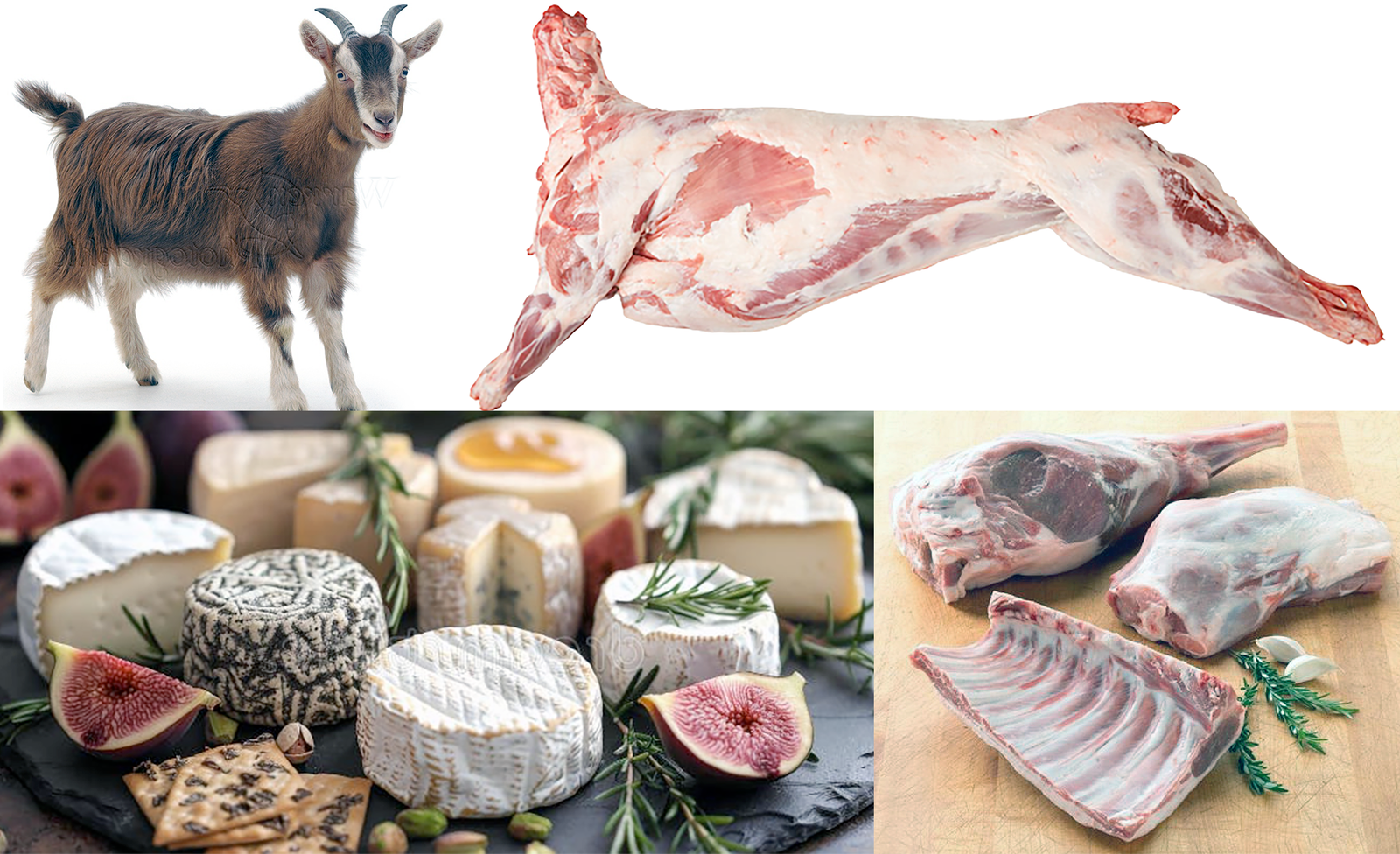 Clockwise from top left: Goat, prepared kid goat, goat meat selection, goat cheese selection.
Welcome to FabulousFusionFood's Goat-based Recipes Page — The domestic goat, Capra hircus is a species of goat-antelope that is mostly kept as livestock. It was domesticated from the wild goat (C. aegagrus) of Southwest Asia and Eastern Europe. The goat is a member of the Bovidae (cow) family and the subfamily, Caprinae, meaning it is closely related to the sheep. It was one of the first animals to be domesticated, in Iran around 10,000 years ago.
Goats have been used for milk, meat, wool, and skins across much of the world. Milk from goats is often turned into cheese. In 2022, there were more than 1.1 billion goats living in the world, of which 150 million were in India.
Goats are among the earliest animals to have been domesticated by humans. A genetic analysis confirms the archaeological evidence that the wild bezoar ibex, found today in the Zagros Mountains, but formerly widespread in Anatolia, is the likely original ancestor of all or most domestic goats today.
Neolithic farmers began to herd wild goats primarily for easy access to milk and meat, as well as to their dung, which was used as fuel; and their bones, hair, and sinew were used for clothing, building, and tools. The earliest remnants of domesticated goats dating 10,000 years Before Present are found in Ganj Dareh in Iran. Goat remains have been found at archaeological sites in Jericho, Choga Mami, Djeitun, and Çayönü, dating the domestication of goats in Western Asia at between 8,000 and 9,000 years ago. DNA evidence suggests that goats were domesticated around 10,000 years ago. Historically, goat hide has been used for water and wine bottles in both traveling and transporting wine for sale, and to produce parchment.
Goats are ruminants. They have a four-chambered stomach consisting of the rumen, the reticulum, the omasum, and the abomasum. As with other mammal ruminants, they are even-toed ungulates. The females have an udder consisting of two teats, in contrast to cattle, which have four teats. An exception to this is the Boer goat, which sometimes may have up to eight teats. Goats are diploid with two sets of 30 chromosomes.
The Modern English word goat comes from Old English gāt "goat, she-goat", which in turn derives from Proto-Germanic *gaitaz (cf. Dutch/Frisian/Icelandic/Norwegian geit, German Geiß, and Gothic gaits), ultimately from Proto-Indo-European *ǵʰaidos meaning "young goat" (cf. Latin haedus "kid"). To refer to the male goat, Old English used bucca (cf. Dutch/Frisian bok, modern English buck) until ousted by hegote, hegoote ('he-goat') in the late 12th century. Nanny goat (adult female) originated in the 18th century, and billy goat (adult male) in the 19th century. Female goats, like other various animals, are also called does. Castrated males are called wethers. While the words hircine and caprine both refer to anything having a goat-like quality, hircine is used most often to emphasize the distinct smell of domestic goats.
Juvenile goats are called kids, a term derived from Old Norse kið, with the same meaning. It has been a slang term for human children since the 1590s, and established as an informal term since the 1840s.
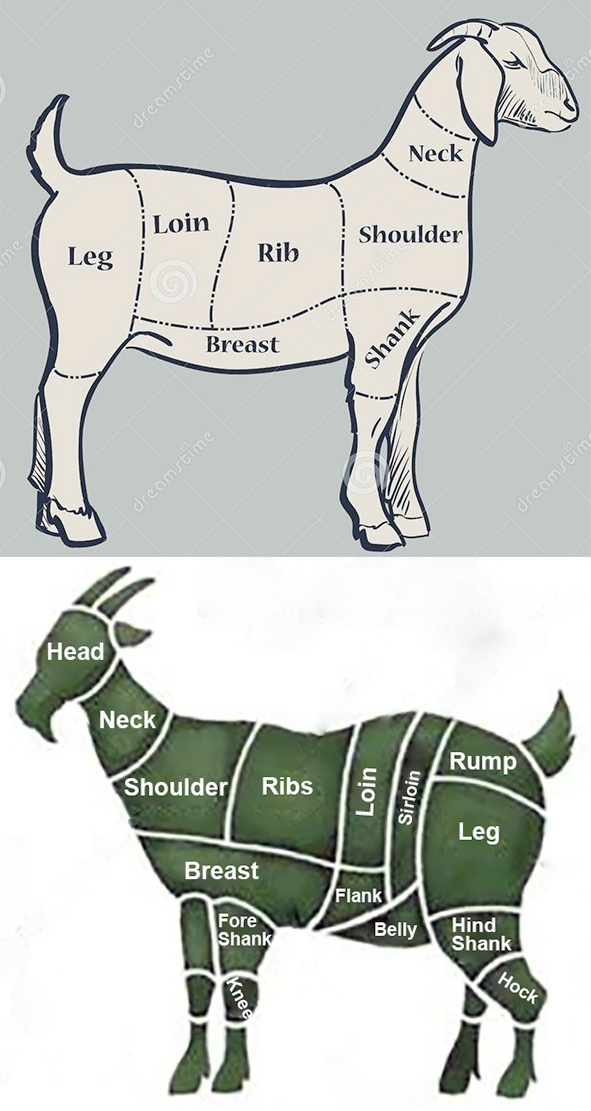 Typical cuts of goat meat, with those for kid goat shown top and a
more mature animal, bottom.
Goat meat is both a staple and a delicacy in the world's cuisines. The cuisines best known for their use of goat include African cuisine, Middle Eastern, Indian, Indonesian, Nepali, Bangladeshi, Pakistani, Abruzzese, Mexican, Caribbean (Jamaica), Haitian cuisine, Dominican cuisine and Ecuadorian. Cabrito, which is baby goat, is a typical food of Monterrey, Nuevo León, Mexico; in Italy it is called "capretto". Goat meat can be prepared in a variety of ways, such as being stewed, curried, baked, grilled, barbecued, minced, canned, fried, or made into sausage. Goat jerky is another popular variety.
Goat has a reputation for having a strong, gamey flavour, but the taste can also be mild, depending on how it is raised and prepared. Caribbean cultures often prefer meat from mature goats, which tends to be more pungent (which is why the meat is first cleaned in a blend of lime juice and water there and it's pre-boiled with the initial boiling liquid discarded), while some other cultures prefer meat that comes from younger goats that are six to nine months old. Ribs, loins, and tenderloin goat meat are suitable for quick cooking, while other cuts are best for long braising. Despite being classified as red meat, goat is leaner and contains less cholesterol and fat than both lamb and beef, and less energy than beef and lamb; therefore, it requires low-heat, slow cooking to preserve tenderness and moisture.
Goat meat cuts tend to be very similar to lamb/sheep cuts (see image) and the cuts are often cooked in similar ways. Though there are some differences in the cuts between kid goats and older goats due to the respective sizes of the animals.
The alphabetical list of all the goat-based recipes on this site follows, (limited to 100 recipes per page). There are 269 recipes in total:
Page 2 of 3
| Goat Water Origin: Antigua | Kansiyé Origin: Guinea-Bissau | Mrefisa Origin: Western Sahara |
| Goat Water Origin: Saint Kitts | Kari Kambing (Mutton or Goat Curry) Origin: Indonesia | Muamba de Cabara (Goat Meat Muamba) Origin: Angola |
| Goat's Cheese Muffins (Goat's Cheese Muffins) Origin: Britain | Kebab with Garlic Origin: Western Sahara | Muqmad (Djibouti Preserved Meat) Origin: Djibouti |
| Goat's Cheese, Pear and Walnut Mini Quiche Origin: Britain | Kede in Bokenade (Kid Goat in Sauce) Origin: England | Mutton Dopiaza Origin: Pakistan |
| Goatherd's Pastry Pie Origin: British | Khasi Ko Masu (Nepali Goat Meat Curry) Origin: Nepal | Mutton Kulambu (Pondicherry Mutton Curry) Origin: India |
| Gode Paest Origin: England | Khela Kalia (West Bengali Lamb Curry) Origin: India | Mutton Masala Origin: Sri Lanka |
| Gongura Mamsam Origin: India | Kid Goat Korma Origin: Anglo-Indian | Mutton Paya Origin: India |
| Gratin Christophine (Chayote Gratin) Origin: Guadeloupe | Kissuto Rombo (Baked Kid Goat) Origin: Sao Tome | Mutton Roganjosh Origin: India |
| Gratin de pommes de terre des Antilles (Antilles Potato Gratin) Origin: Guadeloupe | Kofta Nakhod (Meatballs with Chickpeas) Origin: Afghanistan | Mutton Saag Origin: India |
| Grenada Curry Goat Origin: Grenada | Kofta Nakhod (Meatballs with Chickpeas) Origin: Tajikistan | Mutton Sukha Curry Origin: India |
| Gulai Kambing (Sumatran Goat Curry) Origin: Martinique | Kokoretsi Origin: Greece | Nakelda (Istrian Bread Rolls) Origin: Slovenia |
| Haedum Laseratum (Kid Goat Seasoned with Laser) Origin: Roman | La Salsa de Cacahuete (Peanut Sauce) Origin: Equatorial Guinea | Nalli Nihari (Mutton Shank Nihari) Origin: India |
| Haedum Laureatum ex Lacte (Suckling Kid Crowned with Laurel and Milk [Sausage]) Origin: Roman | Laal Maas (Rajasthani Red Mutton Curry) Origin: India | Nandji Origin: Mali |
| Haedum sive Agnum Parthicum (Parthian Kid or Lamb) Origin: Roman | Lamb Stuffed with Chicken Origin: Montenegro | Nandji Ivorienne Origin: Cote dIvoire |
| Haedus sive Agnum Tarpeianum (Kid or Lamb à la Tarpeius) Origin: Roman | Lamb Tarkari (Lamb Yoghurt Curry) Origin: Nepal | Ngunza et Boule de Manioc (Ngunza and Cassava Balls) Origin: Central African Republic |
| Haedus sive Agnus Crudus (Seasoning for Raw Kid or Lamb) Origin: Roman | Lampara Curry Origin: Sri Lanka | Nigeria Challenge BIR Curry Origin: Fusion |
| Haedus sive Agnus Syringiatus (Boned Suckling Kid or Lamb) Origin: Roman | Maafe (Meat Peanut Stew) Origin: Mali | Nigerian Goat Meat Pie Origin: Nigeria |
| Harira Mauritanienne (Mauritanian Harira) Origin: Mauritania | Malaysian Goat Rendang Origin: Malaysia | Nigerian Goat Stew Origin: Nigeria |
| Hyderabad Mutton Dopyaza Origin: India | Mangsher Brown Stew (Mutton Brown Stew) Origin: Anglo-Indian | Nigerian Meat Pie Origin: Nigeria |
| Iecinera Haedina vel Agnina (Liver of Kid Goat or Lamb) Origin: Roman | Maraq Fahfah (Somali Soup) Origin: Somalia | Nigerian Spiced Goat Meat Pepper Soup Origin: Nigeria |
| Igra Stobá (Liver Stew) Origin: Bonaire | Maraq Fahfah (Somali Soup) Origin: Somaliland | Nigerian Spiced Mixed Meat Pepper Soup Origin: Nigeria |
| Igra Stobá (Liver Stew) Origin: Curacao | Maraq Hilib Ari (Goat Meat Stew) Origin: Somalia | Nyama yeMbudzi (Traditional Zimbabwean Goat Meat Stew) Origin: Zimbabwe |
| Isi Ewu (Spiced Goat Head) Origin: Nigeria | Marolaym Origin: Mauritania | Obe Ata Dindin (Nigerian Red Sauce) Origin: Nigeria |
| Jamaican Curried Goat Origin: Jamaica | Maroumbo ya Nadzi (Tripe with Bananas) Origin: Mayotte | Ofellas Assas (Roast Morsels) Origin: Roman |
| Jamaican Goat Patties Origin: Jamaica | Mattar Paneer Curry Origin: India | Ofellas Garatas (Braised Morsels) Origin: Roman |
| Jerk Kebabs Origin: Jamaica | Mbaqanga (Bean and Goat Meat Stew) Origin: South Africa | Ofellas Garaton (Morsels with Fish-sauce) Origin: Roman |
| Jerked Goat and Plantain Kebabs Origin: Jamaica | Mboro Mboro (Sweet Potato Leaf and Palm Oil Stew) Origin: Senegal | Oodkac (Somali Preserved Meat) Origin: Somalia |
| Jerked Leg of Goat Origin: Jamaica | Mbuzi ya masala (Goat Meat Dry Fry) Origin: Mayotte | Pâtes au Thon (Tuna and Macaroni) Origin: Algeria |
| Jerusalem Artichoke and Kale Gratin Origin: Britain | Methi Kalia (Spicy Fenugreek Meat) Origin: Bangladesh | Paasto Forno (Somali Pasta al Forno) Origin: Somaliland |
| Kabritu Stoba (Stewed Kid Goat) Origin: Aruba | Minchet Abish Wot Origin: Ethiopia | Pakistani Seekh Kebab Origin: Pakistan |
| Kabritu Stobá (Goat Meat Stew) Origin: Saba | Mini Goat's Cheese and Sunblush Tomato Muffins (Mini Goat's Cheese and Sunblush Tomato Muffins) Origin: Britain | Peruvian Goat Stew Origin: Peru |
| Kabritu Stoba (Goat Stew) Origin: Bonaire | Mirkapaya Mamsam Koora Origin: India | Pintade Farcie au Patates Douces (Stuffed Guineafowl with Sweet Potatoes) Origin: Burkina Faso |
| Kabritu Stobá (Goat Meat Stew) Origin: Curacao | Miyan Kuka II (Baobab Leaf Soup II) Origin: Nigeria | |
| Kansiyé Origin: Guinea | Montserratian Goat Water Origin: Montserrat |
Page 2 of 3