FabulousFusionFood's Boiling Recipes 2nd Page
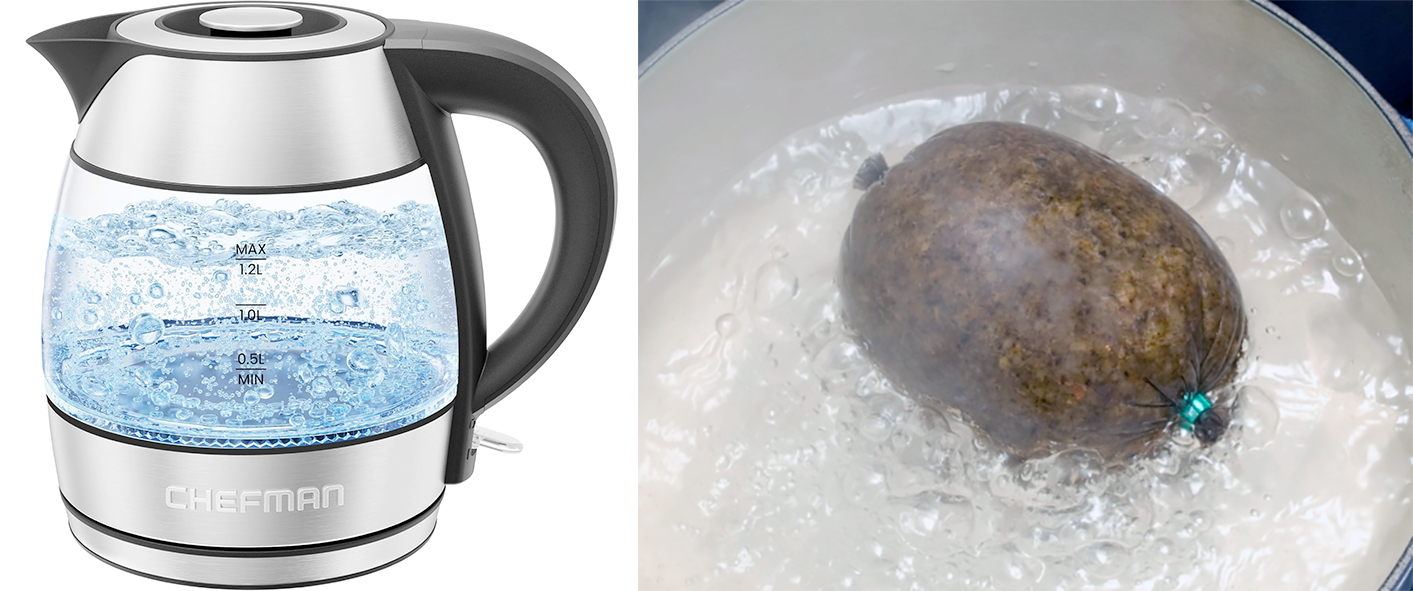 Kettle boiling (left), haggis boiling in pan (right).
Welcome to FabulousFusionFood's Boiling Recipes Page — Boiling or ebullition is the rapid phase transition from liquid to gas or vapour; the reverse of boiling is condensation. Boiling occurs when a liquid is heated to its boiling point, so that the vapour pressure of the liquid is equal to the pressure exerted on the liquid by the surrounding atmosphere. Boiling and evaporation are the two main forms of liquid vaporisation. In cookery, boiling is the process of cooking food in liquid (typically a water base) at the point where the liquid is converting to a gas. Boiling water is also used in several cooking methods including boiling, blanching, steaming, and poaching. Boiling is the method of cooking food in boiling water or other water-based liquids such as stock or milk. Simmering is gentle boiling, while in poaching the cooking liquid moves but scarcely bubbles.
After the control of fire, which was almost certainly used for direct roasting, pit ovens and leather bag based boiling are probably the next developments in cookery. Both rely on a fire heating stones or rocks. For the pit oven, the fire and stones are heated in the bottom of a pit. They're then covered with grass and leaves, which generate steam. The meat is placed on top and the whole is buried. The heat from the fire and the steam cook the food. For boiling in a leather bag, the water and food to be cooked are placed in a leather bag. The hot stones are dropped in and these bring the water and the contents of the bag to a boil. As soon as the ingredients begin to cool drop in another stone... this being the original 'boil in a bag' meal. So, you can boil food long before the invention of pottery or metal working. Indeed, boiling was almost certainly being used as a method of cooking long before the advent of farming. It lends itself to the hunter-gatherer lifestyle as a leather bag is easy to make and light to transport. It can be used to cook seafood, shellfish, game meat and any vegetables or grains that are foraged.
As a method of disinfecting water, bringing it to its boiling point at 100°C (212°F), is the oldest and most effective way since it does not affect the taste, it is effective despite contaminants or particles present in it, and is a single step process which eliminates most microbes responsible for causing intestine related diseases. The boiling point of water is 100°C (212°F) at sea level and at normal barometric pressure. In places having a proper water purification system, it is recommended only as an emergency treatment method or for obtaining potable water in the wilderness or in rural areas, as it cannot remove chemical toxins or impurities.
The boiling point of water is typically considered to be 100°C (212°F; 373K), especially at sea level. Pressure and a change in the composition of the liquid may alter the boiling point of the liquid. High elevation cooking generally takes longer since boiling point is a function of atmospheric pressure. At an elevation of about one mile (1,600 m), water boils at approximately 95 °C (203 °F; 368 K). Depending on the type of food and the elevation, the boiling water may not be hot enough to cook the food properly. Similarly, increasing the pressure as in a pressure cooker raises the temperature of the contents above the open air boiling point (which is why pressure cooking reduces the time required to cook food).
The advent of fireproof pottery allows meals to be cooked by placing the cooking vessel next to the fire. Once metalwork is developed cooking pots can be suspended over a fire, which is why stews feature in so many cuisines. During Medieval times in Europe, boiling was a major way of cooking and both savoury and sweet dishes were boiled, becoming known in English as 'puddings'. This is why, in Britain at least, black pudding, haggis, steamed cakes, Christmas pudding etc are all known as 'puddings'.
Tea and Brewing: As boiling renders water potable and safe, it's interesting how this developed to produce safe drinks in Europe and Asia. In Europe, boiled water was used to make beer, the alcohol in the beer then keeping the water safe and bacteria free for a long time after brewing. In Asia, water was boiled and made into an infusion with green or fermented tea leaves, a drink intended to be imbibed immediately.
The alphabetical list of all the boiling-based recipes on this site follows, (limited to 100 recipes per page). There are 370 recipes in total:
Page 2 of 4
| Eight-treasures Sweet Rice Cake Origin: China | Haggis Origin: Scotland | Kittitian Style Conkies Origin: Saint Kitts |
| Eliza Acton's Herodotus Pudding Origin: Britain | Hapai Hantue (Filled Buckwheat Dumplings) Origin: Bhutan | Knedle sa Sljivama (Potato Dumplings with Plums) Origin: Serbia |
| Eluit el Tuu (Bananas in Coconut Milk) Origin: Palau | Hard Tack Figgy-dowdy Origin: England | Knoepfle Oder Spaetzleteig (Basic Spaetzle Dough) Origin: Germany |
| Elys in Brewet (Eels in Bruet) Origin: England | Harisa (Chicken and Wheat Porridge) Origin: Armenia | Kofta Nakhod (Meatballs with Chickpeas) Origin: Afghanistan |
| Erbowle Origin: England | Heicht mat Kraïderzooss (Pike in Green Sauce) Origin: Luxembourg | Kofta Nakhod (Meatballs with Chickpeas) Origin: Tajikistan |
| Fakalate (Coconut Dumplings) Origin: Tonga | Herodotus' Pudding Origin: Britain | Kokada (Aruban Coconut Candy) Origin: Aruba |
| Farine Grits Origin: Guyana | Hindle Wakes Origin: England | Kokada (Bonaire Coconut Candy) Origin: Bonaire |
| Ffani (Toffee) Origin: Welsh | Home-made Instant Vanilla Pudding Mix Origin: Britain | Kokada (Curaçao Coconut Candy) Origin: Dominica |
| Fish Balls with Green Bananas Origin: Pitcairn Islands | Horehound Candy Origin: Britain | Korean Style Dashi Origin: Korea |
| Flancitos Origin: Chile | Horehound Candy II Origin: Britain | Kriibsen (Crayfish, Luxembourg Style) Origin: Luxembourg |
| Fondant Icing Origin: Britain | Hydrogarata Isicia sic Facies (Boiled Forcemeat with Fish-sauce) Origin: Roman | Kuindiong (South Sudanese Semolina Pudding) Origin: South Sudan |
| Fonio and Oat Balls in Peanut Sauce Origin: Fusion | Idrijski žlikrofi (Slovenian Potato-filled Dumplings) Origin: Slovenia | Kypriakes Ravioles (Cypriot Ravioli) Origin: Cyprus |
| Fonio Balls Origin: Nigeria | Ika Lolo (Fish in Taro Leaves) Origin: Tonga | Ladob Banan (Bananas in Coconut Milk) Origin: Seychelles |
| For to boyle feasant partrychs capons and corlowe (How to Boil Peasant, Partridges, Capons and Curlews) Origin: England | In Echino Salso (Salted Sea Urchins) Origin: Roman | Lakh (Sweet Millet Porridge) Origin: Senegal |
| For to make pomme doryes and other thyngs (How to Make Golden Apples and Other Things) Origin: England | In Isiciato Pullo (For Chicken Forcemeats) Origin: Roman | Laridi Coctura (Ancient Roman Boiled Bacon) Origin: Roman |
| Francatelli Boiled Neck of Mutton Origin: Britain | In Locusta Elixa (Sauce for Boiled Lobster) Origin: Roman | Laumproys in Galyntyne (Lampreys in Galingale Sauce) Origin: England |
| Francatelli Boiled Round of Beef Origin: Britain | In Struthione Elixo (Of Boiled Ostrich) Origin: Roman | Le Tô Sauce Gombos (Tô with Okra Sauce) Origin: Burkina Faso |
| Frankfurter Sausage Origin: Germany | In Torpedine (Of Ray) Origin: Roman | Leche Lumbard (Lombardy Cream) Origin: England |
| Fruit Dumplings Origin: Ancient | In Torpedine Elixa (Sauce for Boiled Ray) Origin: Roman | Lemon Khoya (Condensed Milk Solids with Lemon) Origin: India |
| Fumbyree (Shelled Barley Porridge) Origin: Manx | Isicia de Pavo (Peacock Forcemeats) Origin: Roman | Leporis Conditura (Seasoning for Hare) Origin: Roman |
| Fungee Origin: Antigua | Isicia Plena (Pheasant Forcemeat) Origin: Roman | Let lardes (Milk and Lard) Origin: England |
| Gelee of fleche (Meat in Jelly) Origin: England | Ius in Venationibus Omnibus (Sauce for all Kinds of Wild Game) Origin: Roman | Liewerkniddelen (Liver Dumplings) Origin: Luxembourg |
| Gelee of fysche (Fish in Jelly) Origin: England | Jam Mwyar Duon (Blackberry Jam) Origin: Welsh | Liquorice Caramels Origin: Britain |
| Gem Squash Starter Origin: South Africa | Jiaozi (Chinese Dumplings) Origin: China | Locusta Elixa cum Cuminato (Boiled Lobster with Cumin Sauce) Origin: Roman |
| Gnocchi di Ortica (Nettle Gnocchi) Origin: Italy | Juk Juk (Sticky Rice Balls) Origin: Marshall Islands | Lu Pulu (Corned Beef and Onion in Taro Leaves) Origin: Tonga |
| Gnocchi di semolino alla romana (Roman-Style Semolina Gnocchi) Origin: Italy | Jumalikud Pelmeenid (Dominican Divine Dumplings) Origin: Dominica | Makerel in sauce (Mackerel in Sauce) Origin: England |
| Gnocchi di semolino alla romana (Roman-Style Semolina Gnocchi) Origin: Vatican City | Käsknöpfle (Mini Dumplings with Cheese) Origin: Liechtenstein | Malawi Yellow Rice Origin: Malawi |
| Gnocchi Verdi (Spinach Gnocchi) Origin: Italy | Kadu Ka Halwa Origin: India | Mallow Cheese with Seaweed Paste Origin: Fusion |
| Grenada Rice and Peas Origin: Grenada | Kale with Cream Origin: Ireland | Manti (Meat-filled Boat-shaped Pastry) Origin: Armenia |
| Grenadan Dumplings Origin: Grenada | Karaoli Vrasti (Boiled Snails) Origin: Cyprus | Mantı (Turkish lamb dumplings) Origin: Turkey |
| Gromperekniddelen (Luxembourger Potato Dumplings) Origin: Luxembourg | Kartoffelknoedel (German Potato Dumplings III) Origin: Germany | Mantı (Turkmen lamb dumplings) Origin: Turkmenistan |
| Gunpowder Plot Toffees Origin: Britain | Khinkali Origin: Georgia | Manx Butter Fudge Origin: Manx |
| Gwichiaid (Periwinkles) Origin: Welsh | Khoya (Condensed Milk Solids) Origin: India | |
| Habas con Refrito (Beans with Refried Beans) Origin: Ecuador | Kifta Lil Atfaal (Cinnamon Meatballs) Origin: Libya |
Page 2 of 4