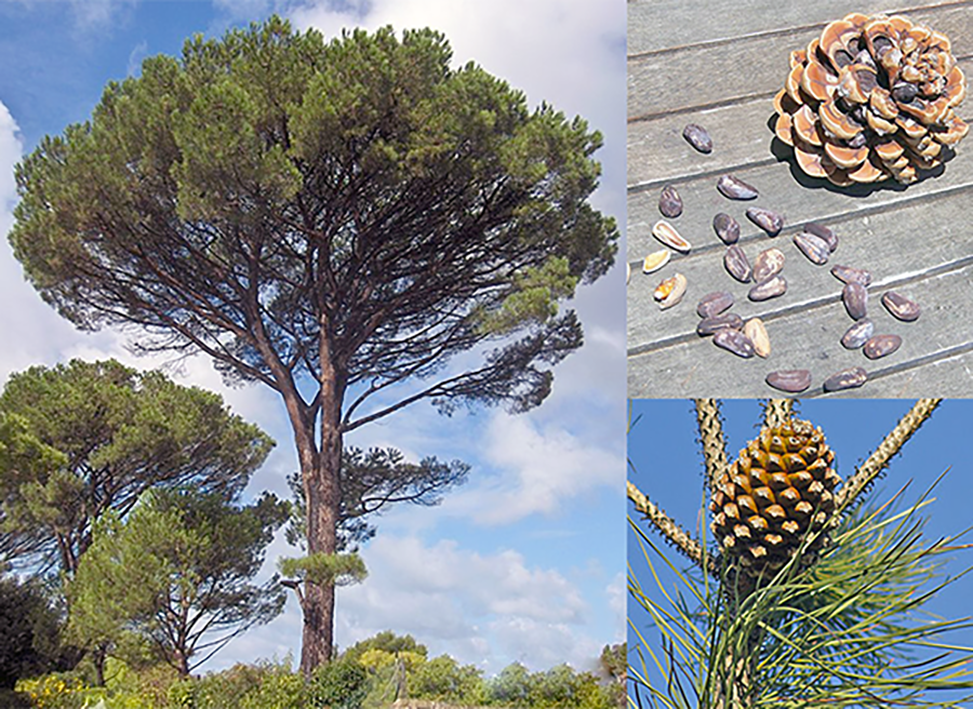
 The image, above, shows the full water Italian stone pine tree
(Pinus pinea), left. Also shown are images of the
mature, open pine cone and the pine nuts from within (top right)
as well as an immature pine cone on the tree (bottom right)..
| Common Name: Italian Stone Pine |
| Scientific Name: Pinus pinea |
| Other Names: Umbrella Pine, Stone Pine, Parasol Pine |
| Family: Pinaceae |
| Range: S. Europe around the Mediterranean. Occasional garden introduction in Britain. |
Physical Characteristics Pinus pinea is a hardy Evergreen tree, growing to 10m (32 ft) by 10m (32 ft) in size. It is hardy to zone 8 and is not found in areas with sustained frost. The plant flowers from May to June and the seeds ripen in April. The flowers are monoecious (individual flowers are either male or female, but both sexes are found on the same tree) and are wind pollinated. The plant is not self-fertile.
|
| Edible Parts: Young Cones, Seed |
 Edibility Rating: 4 Edibility Rating: 4 
|
 Known Hazards: The sap, wood and sawdust of certain pine species can cause contact dermatitis in some susceptible individuals. Known Hazards: The sap, wood and sawdust of certain pine species can cause contact dermatitis in some susceptible individuals.
|
Welcome to the summary page for FabulousFusionFood's Wild Food guide to Italian Stone Pine along with all the Italian Stone Pine containing recipes presented on this site, with 156 recipes in total.
These recipes, all contain Italian Stone Pine as a major wild food ingredient.
This page is a continuation of the list of wild food recipes including Italian Stone Pine held on the FabulousFusionFood site. If you are specifically looking for this site's information on as a Wild Food please navigate to First Page of the Italian Stone Pine Containing Recipes entry on this site.
These recipes, all contain Italian Stone Pine as a major wild food ingredient.
This page is a continuation of the list of wild food recipes including Italian Stone Pine held on the FabulousFusionFood site. If you are specifically looking for this site's information on as a Wild Food please navigate to First Page of the Italian Stone Pine Containing Recipes entry on this site.
The alphabetical list of all Italian Stone Pine recipes on this site follows, (limited to 100 recipes per page). There are 156 recipes in total:
Page 2 of 2
| Palestinian Meat Stuffing Origin: Palestine | Porcellum Coriandratum (Suckling Pig with Coriander Sauce) Origin: Roman | Sun-dried Tomato and Garlic Pesto Origin: Italy |
| Panforte Origin: Italy | Porcellum Lasaratum (Suckling Pig Seasoned with Laser) Origin: Roman | Tart de ffruyte (A Fruit Pie) Origin: England |
| Pangiallo romano (Roman Christmas Cake) Origin: Italy | Potatoes with Pine Nuts Origin: Ireland | Tartlettes/Tartletes (Tartlets) Origin: England |
| Pangiallo romano (Roman Christmas Cake) Origin: Vatican City | Pullus Vardanus (Chicken à la Varus) Origin: Roman | The Ultimate Roast Turkey Origin: Britain |
| Parsley Pesto Origin: Saint Pierre | Pynnonade (A Dish of Pine Nuts) Origin: England | Three-cornered Leek Pesto Origin: Britain |
| Pastai Cig oen Cymraeg a Phwmpen (Welsh Lamb and Marrow Pie) Origin: Welsh | Quemadmodum Sinapis Facias (How to Make Mustard) Origin: Roman | Three-cornered Leek Pesto Origin: Britain |
| Patina Cotidiana II (Everyday Casserole II) Origin: Roman | Roast Lamb with Pesto Stuffing Origin: Britain | Tourta de Blea (Chard Pie) Origin: Monaco |
| Patina Versatilis (Upside-down Dish) Origin: Roman | Rosee (Rose Pudding) Origin: England | Tourtes parmeriennes (Parmesan Pies) Origin: France |
| Patinam Apicianam (Apician Casserole) Origin: Roman | Sala Cattabia Apiciana (Apician Potted Salads) Origin: Roman | Trieste Style Štruklji Origin: Slovenia |
| Patinam ex Lacte (Milk Casserole) Origin: Roman | Sayadieh Samak (Baked Fish with Rice) Origin: Saudi Arabia | Turkey, Squash and Cranberry Ravioli Origin: Britain |
| Payn Ragonn Origin: England | Sea Aster Pesto Origin: Britain | Ut Uncia Laseris Toto Tempore Utaris (How you Can Always Have Laser for Use) Origin: Roman |
| Pepper Pasta Pie Origin: South Africa | Sea Spaghetti with Garlic and Butter Origin: Ireland | Uzum Receli (Grape Jam) Origin: Turkey |
| Pesto alla Genovese (Genoan-style Pesto) Origin: Italy | Sepias Elixas a Balineo (Boiled Cuttlefish from the Tank) Origin: Roman | Valentine Flower Salad with Champagne Vinaigrette Origin: Britain |
| Pesto Bara Lawr a Garlleg Gwyllt (Laverbread and Wild Garlic Pesto) Origin: Welsh | Shellfish Forcemeats Origin: Roman | Veal Involtini alla Siciliana Origin: American |
| Pesto Petiolata Origin: Italy | Shifa (Lebanese Lamb and Pine Nut Pizza) Origin: Lebanon | Ventrem Plenum (Stuffed Pig's Stomach) Origin: Roman |
| Pisam Farsilem (Pressed Peas) Origin: Roman | Slow-roasted Lamb with Advieh Origin: Fusion | Water Mint Pesto Origin: Britain |
| Pisces Scorpiones Rapulatos (Scorpion Fish with Turnips in Saffron Sauce) Origin: Roman | Sorrel Pesto Origin: Italy | Wild Garlic and Wild Mustard Greens Pesto Origin: Britain |
| Pokerounce Origin: England | Squash Moussaka Origin: Armenia | Yalanchy Sarma (Armenian Stuffed Vine Leaves) Origin: Armenia |
| Pollo al Curry con Pasas y Piñones (Chicken Curry with Raisins and Pine Nuts) Origin: Spain | Stuffed Nasturtium Leaves Origin: Fusion |
Page 2 of 2