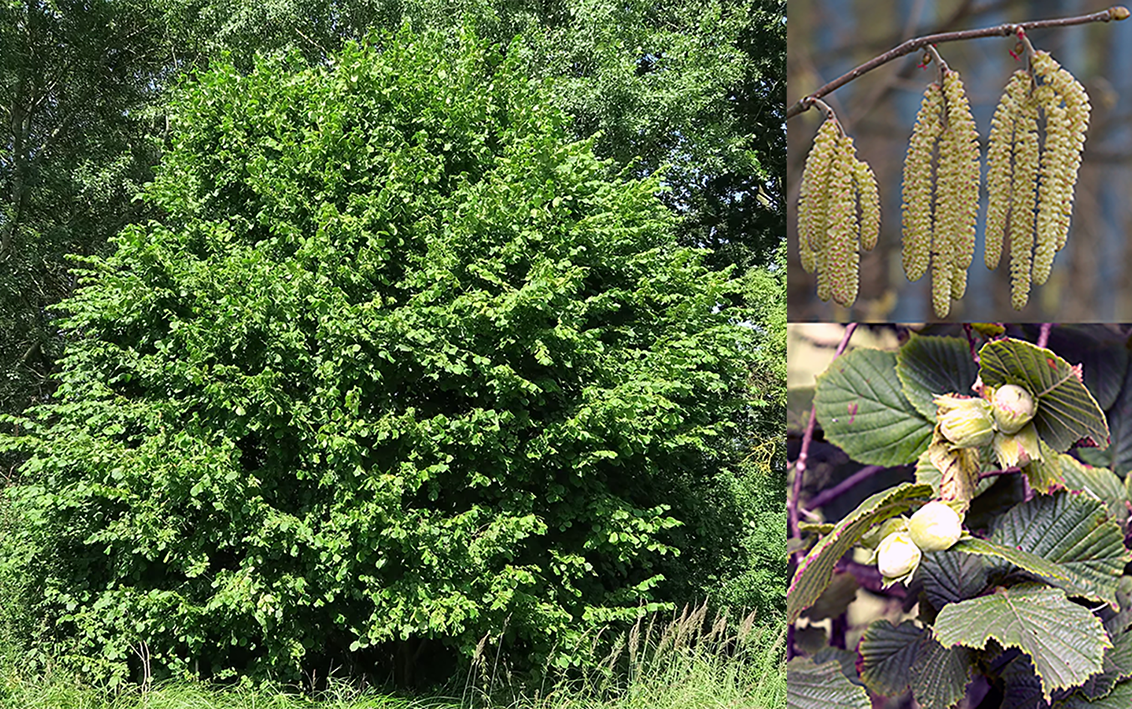
 The image, above, shows the full hazel tree (Corylus
avellana), left, with the male flowers (catkins) top right
and the hazelnuts bottom, right..
| Common Name: Hazel |
| Scientific Name: Corylus avellana |
| Other Names: Cobnut, Hazel, Harry Lauder's Walking Stick, Corkscrew Hazel, Hazelnut |
| Family: Betulaceae |
| Range: Europe, including Britain, from Norway to Spain and east to W. Asia |
Physical Characteristics Corylus avellana is a hardy deciduous tree, growing to 6m (19 ft) by 3m (9 ft) in size. It is hardy to zone 4 and is not frost tender. The plant flowers from January to April and the seeds ripen from September to October. The flowers are monoecious (only one sex per flower), though both sexes can be found on a single tree, and are wind pollinated. The plant is not self-fertile.
|
|
Edible Parts: Nuts, Young Leaves, Catkins (male flowers), Pollen |
 Edibility Rating: 4 Edibility Rating: 4 
|
 Known Hazards: None Known. Known Hazards: None Known.
|
Monthly Availability: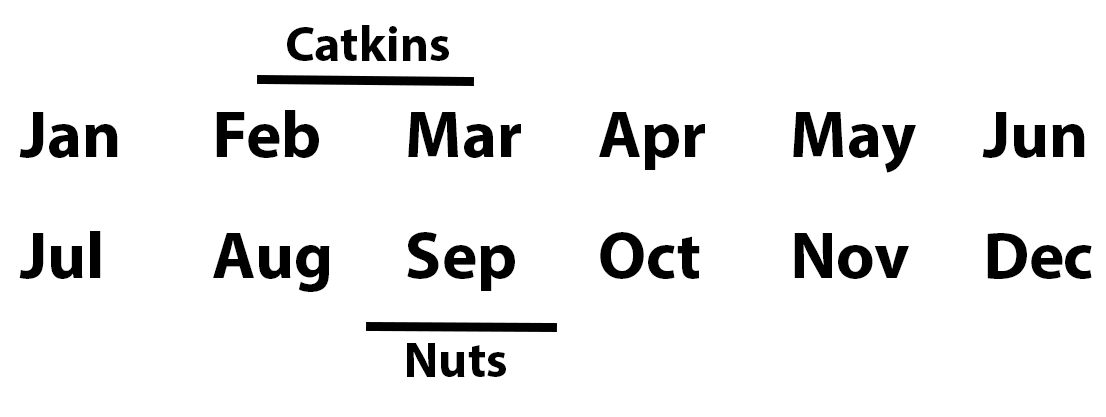
|
Welcome to the summary page for FabulousFusionFood's Wild Food guide to Hazel along with all the Hazel containing recipes presented on this site, with 109 recipes in total.
These recipes, all contain Hazel as a major wild food ingredient.
This page is a continuation of the list of wild food recipes including Hazel held on the FabulousFusionFood site. If you are specifically looking for this site's information on as a Wild Food please navigate to First Page of the Hazel Containing Recipes entry on this site.
These recipes, all contain Hazel as a major wild food ingredient.
This page is a continuation of the list of wild food recipes including Hazel held on the FabulousFusionFood site. If you are specifically looking for this site's information on as a Wild Food please navigate to First Page of the Hazel Containing Recipes entry on this site.
The alphabetical list of all Hazel recipes on this site follows, (limited to 100 recipes per page). There are 109 recipes in total:
Page 2 of 2
| Sticky-spiced Duck Legs with Plums Origin: Fusion | Teisen Frau Noswaith Lawen (Pan-fried Parsnips and Mushrooms with a Garlic and Parsley Crust) Origin: Welsh | Turron de Jijona (Jijona Nougat) Origin: Spain |
| Sweet Chestnut Flour, Hazelnut and Chocolate Cake Origin: Italy | Torta Galesa (Teisen Gymreig) Origin: Welsh | Vegan Burritos Origin: American |
| Swiss-style Muesli Origin: Switzerland | Torta Plava zaguna (Blue Lagoon Cake) Origin: Slovenia | Vegan Gluten-free Christmas Cake Origin: Britain |
Page 2 of 2