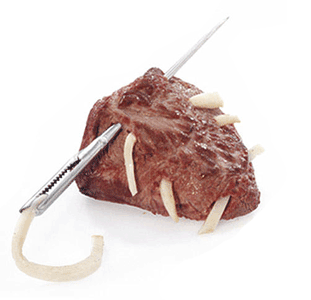
Larding is a traditional British recipe, based on Mrs Beeton's recipe of 1861, for a classic method of keeping game, meat or fowl moist by inserting pieces of fat or fatty bacon prior to cooking. The full recipe is presented here and I hope you enjoy this classic British version of: Larding.
(click this button to prevent the screen from sleeping so Cook Mode is 'ON')
This is a traditional British recipe redacted from the redoubtable Mrs Beeton's 1861 volume Mrs Beeton's Book of Household Management, the classic Victorian cookbook.
Original Recipe
LARDING.
828. INGREDIENTS.—Bacon and larding-needle.
Mode.—Bacon for larding should be firm and fat, and ought to be cured without any saltpetre, as this reddens white meats. Lay it on a table, the rinds downwards; trim off any rusty part, and cut it into slices of an equal thickness. Place the slices one on the top of another, and cut them evenly into narrow strips, so arranging it that every piece of bacon is of the same size. Bacon for fricandeau, poultry, and game, should be about 2 inches in length, and rather more than one-eighth of an inch in width. If for larding fillets of beef or loin of veal, the pieces of bacon must be thicker. The following recipe of Soyer is, we think, very explicit; and any cook, by following the directions here given, may be able to lard, if not well, sufficiently for general use.
"Have the fricandeau trimmed, lay it, lengthwise, upon a clean napkin across your hand, forming a kind of bridge with your thumb at the part you are about to commence at; then with the point of the larding-needle make three distinct lines across, 1/2 inch apart; run the needle into the third line, at the further side of the fricandeau, and bring it out at the first, placing one of the lardoons in it; draw the needle through, leaving out 1/4 inch of the bacon at each line; proceed thus to the end of the row; then make another line, 1/2 inch distant, stick in another row of lardoons, bringing them out at the second line, leaving the ends of the bacon out all the same length; make the next row again at the same distance, bringing the ends out between the lardoons of the first row, proceeding in this manner until the whole surface is larded in chequered rows. Everything else is larded in a similar way; and, in the case of poultry, hold the breast over a charcoal fire for one minute, or dip it into boiling water, in order to make the flesh firm."
Modern Redaction
Ingredients:
meat
fatty bacon or pork fat
larding needle
Method:
In cooking, larding is an important process for introducing additional fat into lean meats such as fillets, fowl breasts and game meats.
Typically this is done by introducing strips of fat into the meat using a larding needle (see above), a thick needle that the fat is either threaded into or which grips the fat with teeth.
Begin with the fat you are going to use for larding. Take fatty bacon or pork fat and cut into thin strips, about 10cm in length, 3mm wide and about 2mm thick.
There are two ways of larding meat. The pieces of lard can be stuck all the way through the meat, as in the image above. This is good for red meats such as veal or beef.
However, for cuts such as the breasts of fowl or game birds it's much more usual to surface lard them. To do this, I will use the example of a pheasant breast. Take the breast and skin it. Punch the breast at the end near you and insert the larding needle. Now pinch the breast about half way along its length and thread the needle through this. Pinch the breast at the far end and thread the needle through this. You will now have the lard running along the breast, but penetrating it only in three places. Repeat this process until you have rows of lard, about 12mm distant running all the way across the breast.
You can also use this larding process to lard whole game birds or fowl.